


 1.svg)


 Home
Home Home cleaning
 Commercial cleaning
.svg) My profile
My profile Blog
Blog About us
 1.svg) Contact
Contact.svg) Bookings
Bookings Cleaning address
 Requisites (for business)
 1.svg) Contact details
Contact details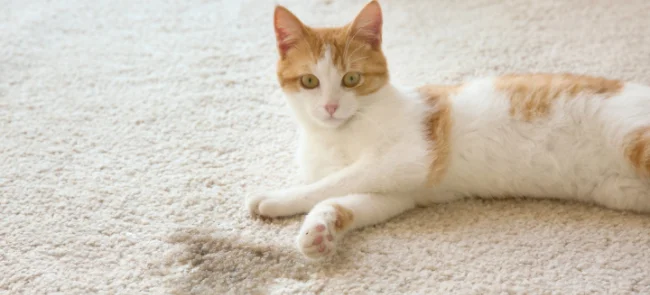
If you’ve ever shared your home with a cat, you know they’re usually fastidious about cleanliness. But every cat owner also knows that accidents happen — and when they do, they tend to happen on the carpet. Few things are as unpleasant as discovering that unmistakable smell of cat urine that just won’t go away.
Maybe your cat missed the litter box. Maybe it’s acting out because of stress, illness, or a recent change in the home. Whatever the reason, you’re left with a stain that feels impossible to clean. The good news? It’s not. You can get rid of the smell and the mark completely — if you know what you’re doing.
Let’s talk about what causes this, how to find the source, how to clean it properly, and what to do to make sure it never happens again.
Why Cats Pee Outside the Litter Box
When your cat suddenly starts using the carpet as a toilet, it’s not being spiteful. There’s always a reason. Sometimes it’s medical — urinary tract infections, bladder stones, kidney problems, or cystitis can all make urination painful, and the cat may start to associate its litter box with discomfort.
Other times, it’s stress. Cats are creatures of habit, and anything from a loud renovation to a new pet can throw them off balance. Even the type or location of the litter box can trigger avoidance. If the box is too small, too dirty, or placed somewhere noisy, your cat might decide the living room carpet seems like a better option.
If your cat’s behaviour changes suddenly, always start with a vet visit. Once you rule out medical causes, you can focus on solving the environmental ones.
Step One: Find the Source of the Smell
You can smell it, but you can’t see it. That’s the tricky part. Dried cat urine doesn’t always leave a visible mark, especially on darker carpets. The best way to find it is to check corners, under furniture, and along walls. Cats prefer quiet, hidden spots.
If that doesn’t work, use your nose or invest in a small UV torch. In the dark, a blacklight will make urine spots glow slightly. Once you find the stain, mark it with tape or a small piece of paper so you can come back to it when you’re ready to clean.
Step Two: Loosen and Lift the Stain
Once you know where the problem is, it’s time to tackle it. The goal is to lift the dried residue and neutralise the smell. You don’t need fancy products — in fact, the most effective cleaners are probably already in your kitchen.
Start with white vinegar and baking soda. Mix equal parts vinegar and water in a spray bottle. Soak the area thoroughly, then let it sit for 20 to 30 minutes. Blot (don’t rub) the area with an old towel or cloth. Once most of the moisture is gone, sprinkle baking soda over the spot and let it dry completely. When it’s dry, vacuum it up. This method neutralises odours and helps lift the stain without damaging carpet fibres.
For older stains, you can add hydrogen peroxide to the mix. Sprinkle baking soda on the area, then pour a mixture of one teaspoon of mild dish soap and 250 ml of hydrogen peroxide on top. Gently scrub the spot with a soft brush, leave it to dry, and vacuum again. It’s a powerful combination that breaks down the compounds that make cat urine smell so strong.
Step Three: Bring in the Enzymes
Sometimes, no matter how much vinegar or peroxide you use, the smell lingers. That’s where enzyme cleaners come in. These are products designed specifically for pet urine. The enzymes actually break down the uric acid crystals in the stain — the real source of the odour — instead of just masking it.
You can find these cleaners in pet shops or supermarkets. Pour a generous amount directly onto the area, let it soak for about fifteen minutes, then blot dry. Don’t rush the drying process — the enzymes need time to work. If the smell remains, repeat the process the next day.
Step Four: Tackle the Odour
Even if the stain looks gone, the smell can hang around for days, especially in humid weather. To get rid of it completely, apply another light mist of vinegar solution or an enzymatic spray. Cover the area with a damp towel overnight. This helps the cleaning agents continue to work deep in the carpet fibres. The next day, remove the towel and let the carpet air dry fully.
If you’re still catching faint whiffs after that, it might mean the urine soaked into the underlay. At that point, a professional deep clean is usually the only way to eliminate it for good.
Step Five: Prevent It From Happening Again
Once you’ve cleaned up the mess, take steps to make sure you don’t have to do it again. Start by addressing why your cat avoided the litter box in the first place.
Keep the litter box large, clean, and in a quiet area. Scoop it daily, wash it weekly, and avoid strong-scented cleaners that might put your cat off. If you have multiple cats, you should have one litter box per cat plus one extra.
Pay attention to your cat’s stress levels too. New furniture, other pets, visitors, or even moving the litter box can cause anxiety. Try to keep their environment stable, and give them a calm, safe space they can retreat to.
Above all, never punish your cat for accidents. It won’t solve the problem — it’ll make it worse. Instead, focus on figuring out the cause and adjusting your routine accordingly.
When to Call a Professional
Sometimes, despite your best efforts, the smell won’t go away. That’s not your fault — once urine seeps into the carpet pad or subfloor, home cleaning can only do so much. This is when calling a professional carpet cleaner makes sense.
Professional cleaners use special equipment and pet-safe cleaning solutions that reach deeper layers of the carpet. They can remove not only the stain and odour but also bacteria that ordinary cleaning can’t reach. Many also offer sanitisation treatments that leave carpets hygienic and safe for both pets and humans.
For Irish homeowners, getting your carpets professionally cleaned once or twice a year isn’t just about appearance — it’s about hygiene and air quality too.
Final Thoughts
Cat urine on the carpet is frustrating, but it doesn’t have to ruin your home. With the right techniques and a bit of patience, you can remove both the stain and the smell completely. Vinegar, baking soda, hydrogen peroxide, and enzyme cleaners are all reliable options, and acting fast makes all the difference.
And if the problem keeps coming back, remember: it’s not just about cleaning. It’s about understanding what your cat is trying to tell you and creating an environment where accidents are less likely to happen.
Clean carpets, a happy pet, and a fresh-smelling home — that’s a win for everyone.
